




Managing a portfolio to provide retirement income is complicated. But as advisors draw a map to help their clients negotiate the twists and turns, they might consider something called a "critical path."
This is the amount of capital, plotted over time, that clients will need to achieve a particular necessary objective. It divides retirees into those who can take risk and those who can't. A theoretical concept, true, but one with useful implications for those designing retirement portfolios. It's a convenient line in the sand between those who take on more conservative positions and those who take on more risk.
The way it works is that retirees on or below the critical path can take no risk. They must instead use investments such as guaranteed products that offer them the closest thing to riskless, bond-like returns. These allow the investor to pass that risk on to a third party.
If they are willing to change their objectives, however, and rise above the critical path, they can free themselves of these restraints. Those above the critical path can invest using traditional strategies that strive for higher returns than what third parties could guarantee them. These investors should design their strategies so that they never become controlled by the constraints of those who shun risk.
One of the more powerful benefits of the critical path is that advisors can use it to explain to clients why they need to modify what might be impossible plans (below the critical path) and instead increase savings, delay retirement or demand less income after they stop working. (See Figure 1.)
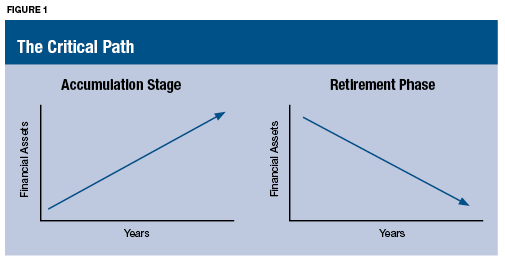
The critical path is based on "risk capacity"-the ability of an investor to take a loss and still achieve a stated objective, such as retiring on time. Most literature, on the other hand, focuses on risk tolerance, a psychological factor, that asks questions such as how much a portfolio can drop before an investor can no longer sleep at night. In 2008, many learned the importance of risk capacity when portfolio losses forced changes in many retirees' plans. The difference between capacity and tolerance is significant.
When an investor is below the critical path, he or she must use riskless investments. In those cases, the investor has said that there is no compromising and no risk can be taken. Some advisors argue that investments with risk have done better historically than riskless ones. But using them would be counter to the clients' guidance.
At the same time, some advisors might ask why those below the critical path must only use riskless investments when they might benefit from traditional investments that have historically offered higher returns. These investors are in effect being restricted to investment purgatory. The reason they are limited is that they have said their objective must be achieved, and traditional investments carry some risk. Rather than taking on risk that could destroy their plans, it might instead be that these investors need to relax their demands.
But it's important to remember that the critical path is a theoretical concept. Truly riskless investments do not exist. And a person's objectives are not likely to be absolute and uncompromising. People change their minds, particularly when given unpleasant choices. Nor should investors be thinking of nominal returns at the expense of real returns. Nonetheless, the critical path offers a useful foundation for building investment strategies in the real world.